
In 1997 I set up in business as a freelance accountant. In 2006 I renamed that business to “Proactive”.

I wanted one short, simple word which I believed could encapsulate the sort of accounting practice that I had already established, and broaden the scope to include business coaching advice. The renewed focus came for a number of reasons.
In 1999 I had first read “7 Habits” by Stephen Covey. Habit Number One is “be proactive”. I saw no reason why I could not adopt that literally and be PROACTIVE☑!
Early in 2005 I had done a retrospective on my progress, and I declared to myself that there is no way that the next eight years was going to be anything like the last eight.
Many businesses fail very early on, yet some manage to struggle through their first three years. It is said that if you can progress beyond that third anniversary then you are clearly on track to building something enduring. I wasn’t satisfied with “enduring”. Having passed the eighth anniversary I wanted “electrifying”! What I discovered is that engineering a steady growth curve can be both electrifying and terrifying!
From about 2004 I had been working with a business coach called John Niland. John had a superb way with words, sharing stories, anecdotes and strategies. I listened carefully, and ultimately I shaped my coaching business along similar lines to his.
I was already on a campaign of reading meaningful books which might help. Quite a few of them did, and a number of books were unceremoniously abandoned. In the early days, one that was particularly profound was “Goals” by Brian Tracy. It was not as life changing as “7 Habits” had been, yet it led to a fundamental shift in my approach to my work/life balance and to a quantum leap in how I did things.
Goals!
How to Get Everything You Want
Faster Than You Ever Thought Possible
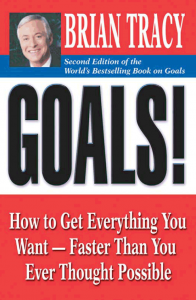
Published in 2003, I first read the book in 2004. By that time I was already working on my own CRM software which I was planning to (a) publish and licence, and (b) I had plans to grow the head count of Proactive to about twenty so that I could be a strategic manager and not be the only qualified accountant. See the 2026 business footnote below.
Amongst all the advice that Brian Tracy gives, one short quote stood out, and one short exercise resonated with me. I had learnt from Stephen Covey and Paul McGee that when an author tells you to write something down, they really mean write it down. I did that with Brian Tracy’s “Perfect Day” exercise.
One Short Quote
Brian Tracy: “Quickly say that’s good to every setback and then find out what’s good about it.”
The Perfect Day
This is my personal synthesis of the core message in the chapter “Manage Your Time Well”.
Tracy did not label it “the Perfect Day”. I call it “the Perfect Day exercise”.
It may have been influenced by a number of other sources I’ve studied. Yet, it is primarily a concept which I ascribe to Brian Tracy, and it’s something all my coaching clients have to do as they begin my Bronze programme.
How to Do the Exercise
Tracy instructs you to take a piece of paper and write a detailed, hour-by-hour description of your absolute perfect day, five years into the future. To make it highly effective, he prompts you to answer specific, vivid questions:
Your Morning: What time do you wake up? What is the first thing you do? What does your bedroom and home look like?
Your Work: What kind of work are you doing? What type of company or business do you own or work for? Who are your colleagues or clients? What are you paid?
Your Leisure: What do you do for lunch? How do you spend your evenings? What do you do for fun, fitness, or relaxation?
Your Relationships: Who are you spending your time with? What are your conversations like?
The Psychology Behind It
Tracy argues that most people set small, uninspiring goals because they are bogged down by their current realities (debt, unfulfilling jobs, or low energy). By projecting five years into the future and pretending your life is already perfect in every way, you unlock two things:
- Clarity on Values – you discover what actually matters to you. You might realise your “perfect day” involves more free time with family rather than working 80 hours a week to buy a grand house.
- Subconscious Programming – it creates structural tension in your mind. Once your brain clearly visualises the “perfect day,” it naturally begins looking for opportunities, habits, and choices in the present to close the gap between your current reality and that future vision.
Time Frame
As a youngster the idea of visualising five years in the future is probably fine (if a bit difficult). As you age you begin to think in terms of ten years and then twenty years into the future. My concept of time has changed. I started at university as a mature student aged 29 and for many years I used to describe that as mid-life. It’s all relative. Now in my sixties I think of mid-life as being aged 50 when I completed my first marathon (Milton Keynes). My concept of my perfect day has also changed over the years.
Do yours now – with a five year time frame. Then in five years do it again, with whatever new time frame resonates with you.
Business Footnote 2026
“Focus CRM” did exactly what I wanted, as a user, and specifically, as an accountant. It did things which commercially available software did not. A side project which took me more than ten years to write (part time, evenings and weekends). It was in daily use from September 2015 to March 2026 when I retired from mainstream work.
A staffed office was established in Folkestone, and the headcount at Proactive eventually numbered five.
Neither of those things would have happened without a plan.